Category Archives: Uncategorized
Posted in Uncategorized
Permalink Enter your password to view comments.
The Romantics Return: William Blake on the BBC
So absolutely glorious to hear the two versions of “Jerusalem” at the Proms last evening – not only Hubert Parry’s traditional version, but Errolyn Warren’s delicious re-visioning “Jerusalem – our clouded hills” in which she
has added a blues feeling and African rhythm.
Subtitled ‘our clouded hills’, her piece is dedicated to the Windrush generation and encourages a communion of Commonwealth nations…
(the BBC Last Night of the Proms 2020 is available on i-player for the next month).
It made me turn to the Blake Archive to look up Blake’s designs for Jerusalem created between 1804-1820, including this dramatic title page:
Jerusalem – The Emanation of the Giant Albion (Yale Centre for British Art).

With more detail on the website, the Tate summarises the complex poem:
In Jerusalem, Albion (England) is infected with a ‘soul disease’ and her ‘mountains run with blood’ as a consequence of the Napoleonic wars. Religion exists only to help monarchy and clergy exploit the lower classes. Greed and war have obscured the true message of religion. However, if Albion can be reunited with Jerusalem, the story goes, then all humanity will once again be bound together with love.
*
And did those feet in ancient time,
Walk upon Englands mountains green:
And was the holy Lamb of God,
On Englands pleasant pastures seen!
And did the Countenance Divine,
Shine forth upon our clouded hills?
Intriguingly, “Jerusalem” – the song we all know, with its music written by Hubert Parry and its orchestration by Edward Elgar – is actually from Blake’s poem “Milton” in which he recalls the possibility that Jesus had once travelled to England (Glastonbury) with Joseph of Arimathea.
And was Jerusalem builded here,
Among these dark Satanic Mills?
If so, and the dark satanic mills of Blake’s contemporary world – with its Enlightenment science and industrial rationalism – were obscuring the spiritual knowledge and perceptive vision that Heaven was once here, then
Bring me my Bow of burning gold:
Bring me my Arrows of desire:
Bring me my Spear: O clouds unfold:
Bring me my Chariot of Fire!
I will not cease from Mental Fight,
Nor shall my Sword sleep in my hand:
Till we have built Jerusalem,
In Englands green & pleasant Land.
*
It’s that ‘Mental Fight’ that is so important here – the power of art, poetry, the creative imagination – and takes us to Simon Schama’s new series The Romantics and Us in which (in part one, “Passions of the People”) William Blake also makes a significant appearance as “one of the founding fathers of Romanticism”.
Living in a “city growing fat with the profits of Empire” where everyday he saw the extremes of wealth and destitution, Blake was, in Schama’s (really quite emotional tone) “always reaching for that bit of Heaven as he sees everybody as potentially wonderful. That’s his adorable thing… that’s how he sees the world even in the middle of… filthy, cruel, ferocious meat-grinder London.”
I’d highly recommend watching it as Testament brings home the relevance of Blake today and Simon Schama marks the passions of William Blake, Eugene Gericault, Mary Wollstonecraft and others and the impact they’ve had on our subsequent histories.
*
Have we, in 2020, entered a new Romantic Age?

Orc – a vigorous youth, surrounded by the fires of revolutionary passion – symbolises the spirit of rebellion and the love of freedom [Tate].
***
Posted in Uncategorized
Posted in Uncategorized
Permalink Enter your password to view comments.
Posted in Uncategorized
Permalink Enter your password to view comments.
Picture Postcard: Two extraordinary Elizabethan Portraits
I’ve just watched James Fox’s “A Very British Renaissance: The Elizabethan Code” on BBC i-player (available for the next few weeks) and he highlighted two extraordinary paintings from the Elizabethan Age, well worth watching (from about 14minutes in).
The first stretches the concept of what a portrait might be:
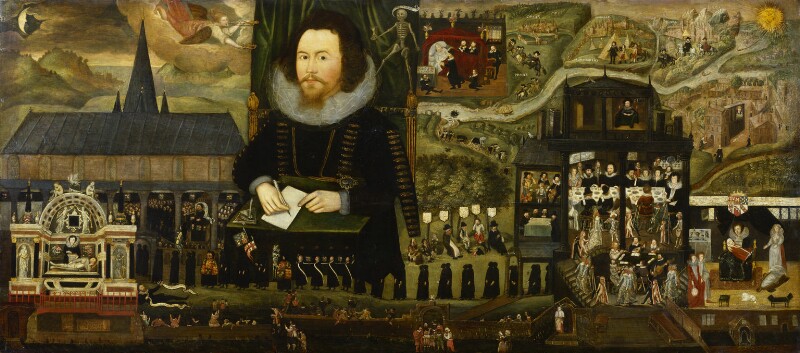
It’s a “portrait” of Sir Henry Unton, commissioned by his widow in about 1596 and at the National Portrait Gallery. Unfortunately the artist is unknown, but the painting shows scenes from Upton’s life – from birth in the lower right hand corner to his death.
I find it quite amazing – indeed rather exciting! It seems to recall medieval church wall-painting rather than suggesting the ‘face’ portraits that would come to dominate British art.
The second rather fabulous painting James Fox discusses is again a portrait which currently resides in the archives of Northampton Art Gallery:
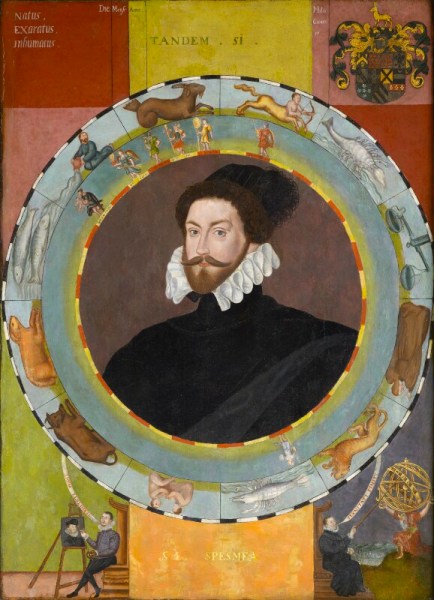
Sir Christopher Hatton, by an unknown artist again (although the artist has pictured himself at the bottom left).
In turn the painting includes all sorts of symbolism to decode – and what brilliant colours! – but to fully appreciate the whole it also needs to be turned about as the imagery continues onto the back.
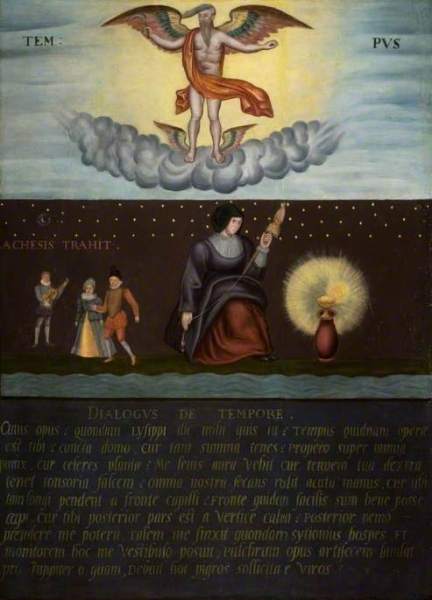
There are some notes about the work online at artuk.org – including the possibility that the artist was from the studio of portrait painter William Segar (1554-1633) and even that an astrologer (depicted at the bottom right?) may have been involved in the painting.
Otherwise there seems to be very little information, so it’s fascinating to see the programme.
And how very intriguing these pictures are, so very “eccentric” – showing, as Fox says, that English Renaissance painting was experimental, rich and sophisticated.
***
Posted in Uncategorized
Toulouse-Lautrec & The Englishmen at the Moulin Rouge
In 1892, Henri de Toulouse-Lautrec painted “The Englishman at the Moulin Rouge”, now in The Metropolitan Museum, New York. The Englishman in question is William Tom Warrener (1861-1934) who had become friends with Lautrec in the early 1890s.

Henri de Toulouse-Lautrec (1864-1901) The Englishman at the Moulin Rouge [1892, Metropolitan Museum, New York]
Patrick O’Connor (1) suggests there is a sly irony to the scene: the Englishman is mischievously characterised with a certain embarrassed reserve – note his reddening ear – as he enters into conversation with the two ladies of the Moulin Rouge (2). That the working title for the piece was “Flirt” (3) also suggests the perhaps risqué nature of their talk. Nevertheless, the painting would serve as the basis for a poster of the same name (Musee Toulouse-Lautrec), the man now reduced to a near shadow (to represent Englishmen in general, rather than portraying Warrener in particular). However, Warrener does then turn up again in another of Lautrec’s 1892 paintings: “Jane Avril Dancing”, now in the Musee d’Orsay (4) – he is at the back of the scene with an unidentified woman.


So, who was William Tom Warrener? And what was he doing in Paris in the early 1890s?
Well there is sadly rather little information on him (5), especially at this time in his life. Julia Frey writes that he was “a painter from an influential English family, who had moved to Paris in the mid-1880s to study at the Academie Julian. He moved to Montmartre in the 1890s where he met Henri [Toulouse-Lautrec]” (p.314). And, in fact, he showed work at the Paris Salon, not returning to his hometown of Lincoln until 1906 where, whilst taking up his role in the family (coal) business, he also set up the Lincolnshire Drawing Society and would, later, become President of the Lincolnshire Artists’ Society. A number of his paintings and sketchbooks (6) are now held by the Usher Gallery in Lincoln, examples of which can be seen on the artuk.org website revealing that whilst in France he worked at the artists’ colony Grez-sur-Loing and explored the bright sunlit colours of Impressionism.
However, there are also two paintings that come from his adventures in Montmartre with Toulouse-Lautrec: “Quadrille I” and “Quadrille II” (both dated circa 1890 and both in the Usher Gallery collection).

Later in her biography of Toulouse-Lautrec, Julia Frey notes: “In the late 1880s and early 1890s, he befriended a number of younger English artists in Paris” (p.384). These included William Rothenstein who, in 1931, would write up his recollections of the time he spent in Paris as a young art student (7), recognising both the thrill and the folly of bohemian life as he moved from the Left Bank “all very well for poets and scholars” to Montmartre “essentially the artists’ quarter” – he was just seventeen years old.
“Puvis de Chavannes had a studio on the Place Pigalle, while Alfred Stevens lived close by, and in the Rue Victor Masse lived Degas. At Montmartre also were the Nouvelles Athenes and the Pere Lathuille, [cafes] where Manet, Zola, Pissarro and Monet, indeed, all the original Impressionists used to meet. The temptation, therefore, to cross the river and live on the heights was too strong to resist” (p.56).
It was at a restaurant in Place Pigalle that he used to meet with friends for lunch:
“The Rat Mort by night had a somewhat doubtful reputation, but during the day was frequented by painters and poets. As a matter of fact it was a notorious centre of lesbianism… [and] it was here that I first met Toulouse-Lautrec…” (p.59).
Then there was, of course, the Moulin Rouge:
“[A]n open air café-concert where one could watch people sitting and walking under coloured lamps and under the stars. Inside the great dancing hall, its walls covered with mirrors… was the dancing of the cancan. …In most places dancers performed on a stage; at the Moulin they mixed with the crowd… suddenly the band would strike up, and they formed a set in the middle of the floor, while a crowd gathered closely around them. It was a strange dance; a sort of quadrille, with [the men] twisting their legs into uncouth shapes… their partners [with] one leg on the ground, the other raised almost vertically, previous to the sudden descent – le grand ecart” (p.62).
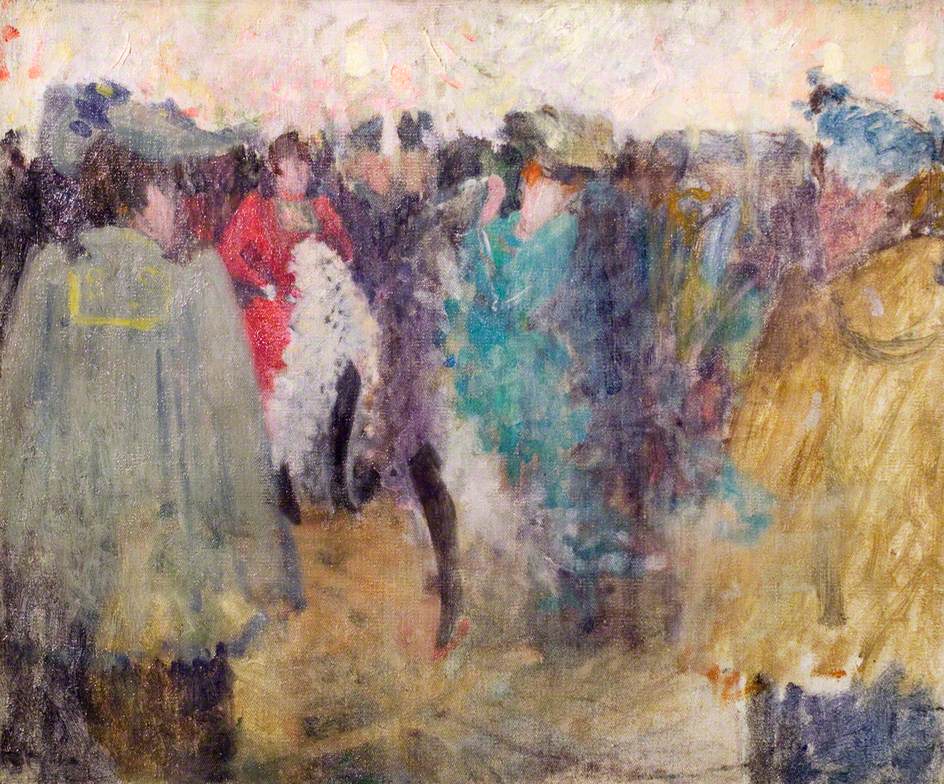
Another student artist in their group was Charles Conder who, one evening – “having drunk more than was good for us” – suggested they paint the Moulin Rouge dancers “there and then”. Whilst I haven’t traced the “wild results” of Rothenstein’s painting-spree, the Manchester Art Gallery has Conder’s “The Moulin Rouge” (1890) which may well have been painted that drunken night.

Indeed the script at the bottom-right of the painting reads:
“CHAS. CONDER. TO. CHAS. ROTHENSTIEN (sic) / IN MEMORY. Of. A. PLEASANT EVENING. / 30.OCT.1890.” (8)
“Can anyone wonder that [we] were fascinated by this strange and vivid life?” (p.62), asks Rothenstein – indeed, it must have been an extraordinary time for these young artists there with the ‘in-crowd’ of bohemian Montmartre.
***
Please note: this is just the beginning of a longer research piece on British artists in late 19th-century France. Any further resources or references you may have would be greatly appreciated. Please contact via Twitter @TheCommonViewer.
***
(1) Patrick O’Connor: “Toulouse-Lautrec: The Nightlife of Paris” (Phaidon, 1991, p.32)
(2) The women have been identified as Rayon d’Or and La Sauterelle: http://www.metmuseum.org/art/collection/search/437835; although biographer Julia Frey suggests they might be La Goulue and La Mome Fromage
(3) Julia Frey: Toulouse-Lautrec – A Life (Weidenfeld & Nicolson, 1994, p.314)
(4) https://www.musee-orsay.fr/en/collections/works-in-focus/painting/commentaire_id/jane-avril-dancing-8969.html?cHash=8fc9922fcb
(5) See Wikipedia for a brief biographical overview: https://en.wikipedia.org/wiki/William_T._Warrener
(6) The sketchbooks in the The Usher Archives are undated and not digitised. I must say a huge thank you to the Collections Development Officer at Lincoln County Council, Dawn Heywood for the kind help and information she has found.
(7) William Rothenstein: “Men and memories: Recollections of William Rothenstein 1871-1900” (Faber & Faber, 1931) (8) Many thanks to Manchester Art Gallery for this information. (9) There’s an extraordinary – indeed surrealist – picture by Charles Conder at The Fitzwilliam Museum, Cambridge called “A Dream in Absinthe” from 1890 (see http://webapps.fitzmuseum.cam.ac.uk/explorer/index.php?qu=Charles%20Conder%20Absinthe&oid=14761)

Posted in Uncategorized
Review: The 58th Essex Open exhibition at The Beecroft Art Gallery
There is a thrill and a challenge in viewing the current Essex Open exhibition.
The thrill is that of variety, for there is no single subject theme or painting style taken up by the artists of Essex; nor – although the exhibition consists primarily of oil paintings – one medium, for there are watercolours, prints, photographs and sculptures. The challenge, then, is for the viewer: how to take on board the diversity before us as each artefact demands we look at it differently to the previous one. By the time we have reach the end of such an extensive show – divided across two floors of The Beecroft Gallery – we are exhausted, having worked our way through so many ways of seeing and responses. Looking back at the experience, certain elements rise to the surface of course; but, truly, one should return to look again and again.
(nb: images were photographed by me and are only details of the complete artworks)


“Sunlit Dinghies” by Anita Pickles & “View from Chester Wall” by Malcolm Perry
So how should we approach this exhibition? Perhaps that geographical “Essex” might be the key, for certainly many of the pictures reflect local life and everyday scenes. “Sunlit Dinghies” by Anita Pickles is an image we all recognise immediately: it could be anywhere along the coast of Essex, the tide out, the scene a snapshot as we walk along the beach on a sunny afternoon; the scent of sea air palpable. Come into town, and Malcolm Perry’s “View from Chester Wall” is again so recognisable and, despite presenting a particular place, stands for so many of our towns and streets: the bustle of Saturday afternoon shopping; the architecture of historical Essex. As with Pickles’ work, it is a view that captures both an immediately present-day scene, yet one that has been this way forever, and so stirring personal and shared memories.
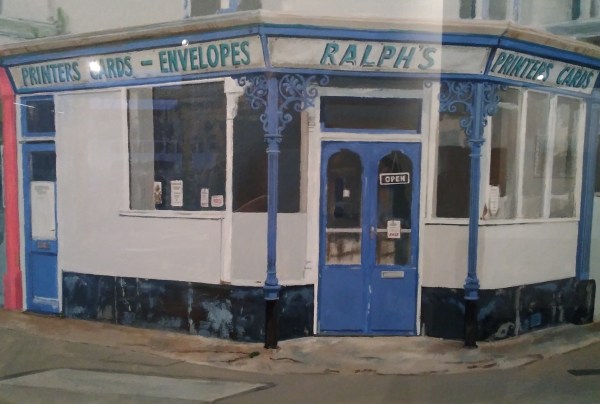
“Ralph’s – Corner of Park and Hamlet” by Stephen Gibbs
And I couldn’t resist “Ralph’s – Corner of Park and Hamlet” by Stephen Gibbs. Again it brilliantly captures an immediately recognisable scene, a somewhat dilapidated shop on a street corner that we probably pass every single day never thinking it should be elevated to ‘art’. It resonates with familiarity, as if it couldn’t be of anywhere else but Westcliff; and it stands for something – all those independent shops and businesses that cluster around Hamlet Court Road, ramshackle yes, barely surviving probably, yet remaining stubbornly “open”.


“Turbulent Sky over Fen Bridge” by Paul Franks & “Picardy Flowers” by Liz Hine
Whilst Gibbs’s picture can be framed within a ‘local’ ‘Essex’ theme, we might also recognise it within the broader contexts of art history – paintings of shopfronts by both Whistler and Sickert come to mind. Indeed a number of works in this current exhibition echo other – more famous – artists and pictures. “Turbulent Sky over Fen Bridge” by Paul Franks cannot but recall Constable in those looming, darkening clouds and gorgeously rich colours as the light picks out the bridge among the trees. It is – almost essentially – East Anglian. Then, alongside, is Liz Hine’s “Picardy Flowers” which makes us long for summer, to lie down in a field and gaze up into a blue, blue sky.
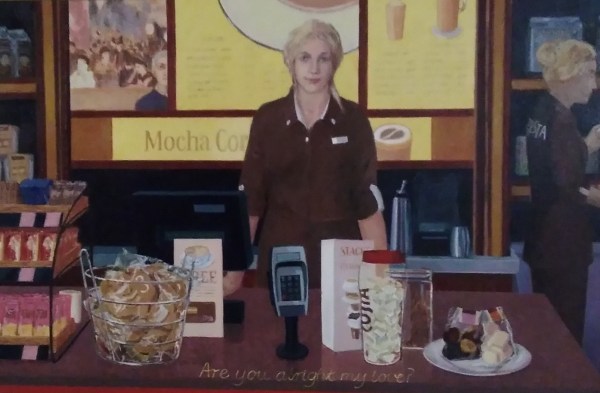
“Costa” by Alan Woods
A more playful echoing is “Costa” by Alan Woods which transports Manet’s “A Bar at the Folies-Bergere” to a coffee shop in… Southend High Street? Well, it could be anywhere really. That’s perhaps the irony; the Folies-Bergere being so singularly unique; Costa so ubiquitous. Should we understand this young woman behind the counter as an icon of our times? We bestow a Romantic gaze upon Manet’s painting – imagining the bars of 19th-century Montmartre with a bohemian delight that a Costa coffee-shop could never inspire. Yet the Impressionists sought to portray ‘modern life’ – look at Manet’s barmaid again, for those bars and cafes weren’t such glamorous places at all, indeed they could be rough and threatening – she doesn’t look happy. The refrain on Gibbs’s picture reads “Are you alright my love?” which might be what the barista is asking us, but perhaps it’s what we should be asking her.


“Promenade” by William Barr & “Stand Up” by Adam Smith
A very different sort of play is afoot in William Barr’s “Promenade” as it toys with our senses: how can we look at it in a way that makes sense? Look ‘straight on’ and it seems to be an abstract ‘face’ (is it a dog, even?), the eye reflecting sea and sky; the yellow, then, might refer to a beach. Re-focus and the picture turns into a map, or an aerial view of the shoreline. Perhaps. It is brilliantly defiant. A description that might also encompass some of the sculptures in the exhibition. Adam Smith’s “Stand Up” consists of four standing panels, each collaged with images, colour and graffiti-like painting. Abstract, decorative and mesmerising, it defies categorisation, rejects labelling and refuses any translation into descriptive words: it is, for me, one of the most exciting exhibits on show.
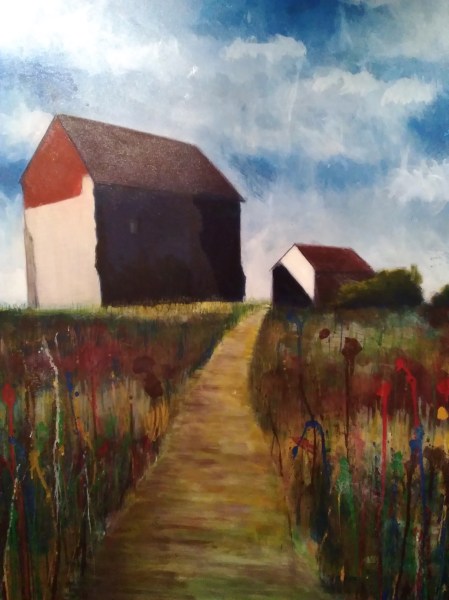
“On-the-Wall Revisited VI” by Steve Whittle
Depictions of local sights and scenes, echoes and allusions to a broader art history, the experience of pure aesthetic sensation… there is one painting that, for me personally, brings each of these elements together: “On-the-Wall Revisited VI” by Steve Whittle. It’s subject is the Chapel of St Peter-on-the-Wall in Bradwell-on-Sea which has been standing against sea and sky for centuries, a place of pilgrimage, peace and spirituality set in contrast to wild nature at the edge of land and sea. Whittle captures the awe of this monumentality within the thrilling drama of art-making itself as we witness the dripping, layering, blending and scratching of colour in his portrayals of grasses and flowers.
So many other paintings should be mentioned, but the exhibition runs until 16th February – and it’s well worth a visit!

Posted in Uncategorized
Steve Whittle: A Review of Recent Works
[Published in the Southend Echo, Friday 14th July 2017, p.35]
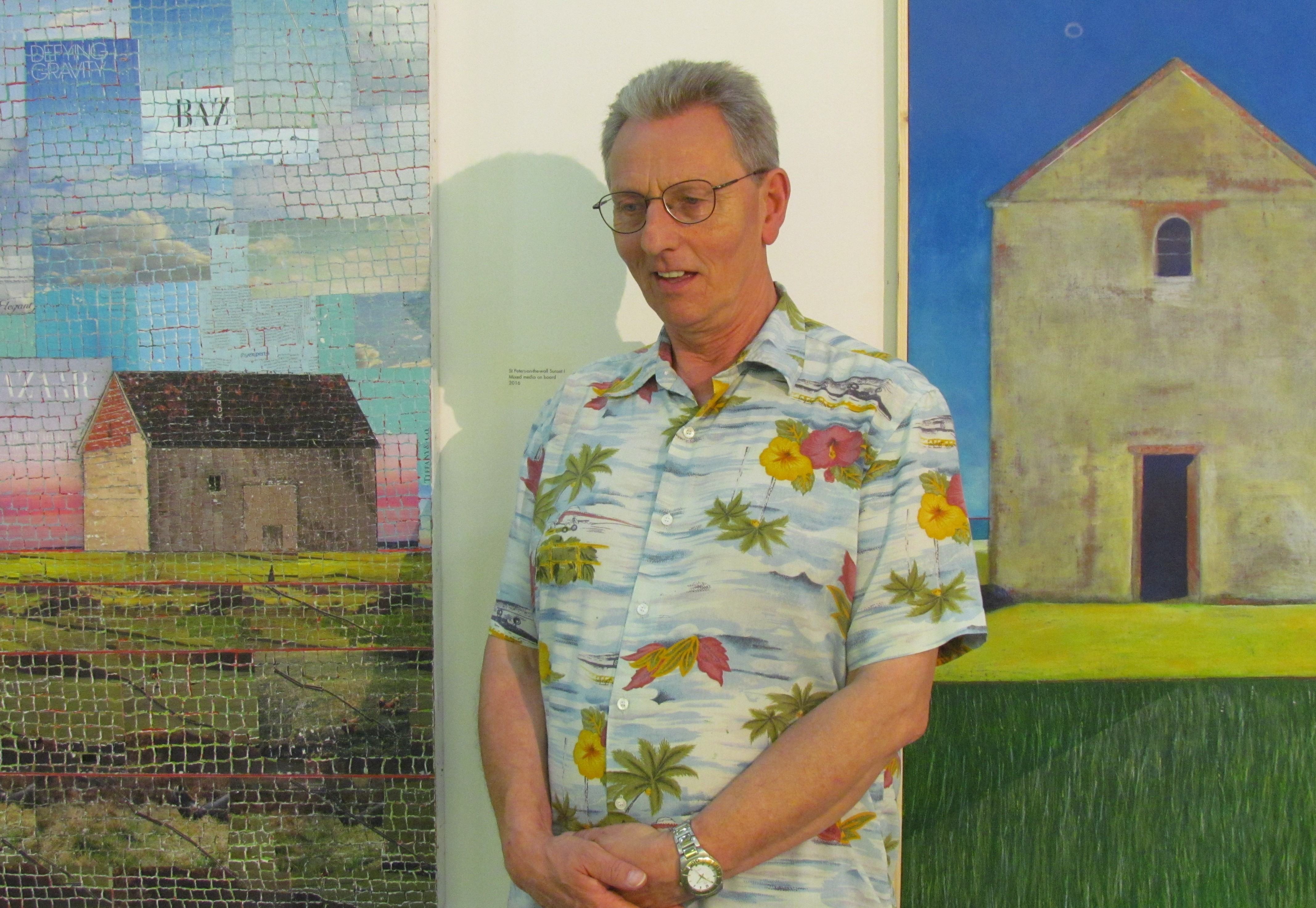
The Spirit of Place
Local artist Steve Whittle, whose work is on show at The Beecroft Gallery until July 22nd, trained at the Central School of Art in the heady days of 1960s London. For much of his career he then balanced being a professional artist with secondary-school teaching, but for the last eight years his focus has been exclusively on making art.
The current exhibition is of recent work primarily, yet it also includes a few early paintings, including minimalist abstracts in which colour squares, precisely angled, shimmer and vibrate on the canvas. Colour is very close to the heart of Whittle’s work, and when I talk to him, he mentions Bridget Riley, Francis Bacon and David Hockney – all exceptional modern colourists.
Whittle’s practice is to regard a single subject closely through a series of different media sometimes over a number of years, and one of the new projects that particularly caught my eye focuses The Chapel of St Peter-on-the-Wall which has stood in Bradwell-on-Sea since the 7th century when St Cedd founded a religious community there.
Asking what had drawn him to this ancient Chapel, Whittle says it’s almost impossible to put into words, he’d felt a primal and immediate connection on his first visit and had to return again and again. That powerful pull has resulted in a number of works, including charcoals, pastels, paintings and collages, all of which portray the extraordinary sense, or spirit, of place – remote, lonely; glorious and powerful – the austere silhouette of the Chapel monumental against the sea and sky.
For Whittle, painting is a process of continually building up and scraping back to reveal colours and layers – in his paintings of St Peter’s the sky is a deep, rich clear jewel-like blue; the chapel has the tactile quality of ancient stone; whilst the grass, despite a perfectly edged lawn, rasps with spear-like texture – as if in recognition that the nature of this remote landscape cannot be truly tamed.
The collages are made of torn pages from high-quality fashion magazines; the detail and texture of these reflect the stonework of the Chapel and on the pieces that form the sky, we can see words, portions of paragraphs and part titles of articles – one, by chance, reads ‘the medieval modernist’. I’m fascinated by these. Fashion, of course, is always now, always modern; magazines are such ephemeral products – read today, thrown away tomorrow. Yet here they serve a history that stretches back almost fourteen centuries. I stand looking, careering back and forth in time.
To the common viewer, these pictures seem a million miles from his early work yet, with gracious subtlety, Steve Whittle suggested I should perhaps look again, for artists build up their vocabulary over the years, a means to visual expression. The serialisation of works built around a single subject, the regular pattern of the torn squares in the collages – both are very much the poetry of that systemic minimalism that had gripped him as a student. Then I saw the red line. I had completely missed it: a precisely drawn red line shimmering and vibrating on the horizon behind the Chapel.
“Recent Works” is a fascinating exhibition that calls for the viewer’s deep engagement; swept up in the vibrancy of colour we are cast into the dramatic perspective of this ancient chapel on the edge of the world made splendid in Steve Whittle’s unique artistic sensibility.
ML Banting
@TheCommonViewer
The Beecroft Art History Group meets 10.30am every last Saturday of the month.
Posted in Uncategorized
Artists-on-Sea: An Evening with Simon Fowler & Rachel Lichtenstein at The Beecroft
Join photographer Simon Fowler and author Rachel Lichtenstein to discuss the Estuary in words & pictures – 6pm on Friday 7th July at The Beecroft Gallery. All welcome. £5 on the door includes a glass of wine (or two!) – but please RSVP by email to chasingtales@rocketmail.com

Posted in Uncategorized
The Great War: Artists on the Frontline
[Notes from “Art and World War I” discussion at The Beecroft Gallery, @Southend Museums, May 2017]
The anniversary of the 1914-1918 war has been recognised with numerous books, exhibitions and artworks as we remember the millions of people killed, the millions more caught up in the first ‘modern’ war; the all-encompassing horror that reached across the world.
Whilst in 1914 young men were taking up the call to arms with patriotic vigour and adventurous enthusiasm, it wasn’t all over by Christmas and the year 1915 saw untold slaughter. Men with horrendous injuries – physical and mental – were coming into the hospitals with fearful stories: experiences that seemed incompatible with the “all to victory” slogans of the newspapers. In visual culture similarly, the war images were primarily “inspirational” portraits of the King and military leaders in uniform, or the call-to-arms posters pasted on every other lamp-post.
“The lamps are going out all over Europe, we shall not see them lit again in our lifetime” declared British Foreign Secretary Sir Edward Grey – culture, even civilization itself, appeared to be at an end. The avant-garde artists of Europe, may of whom had been active in the brilliant cauldron of creativity that was Paris, were now forced to leave their easels and return to their home nations, many signing up of course to military service. “Rent or furled are all Art’s ensigns” wrote Wilfred Own in his poem “1914”.
It wasn’t until 1916 that a growing recognition of the importance of visual art inspired the formation of an official enterprise. Initially under the remit of the propaganda department at Wellington House, then incorporated into the Ministry of Information; the War Artists scheme would lead to exhibitions both across Britain and abroad; magazine publications such as “The Western Front” and “British Artists at the Front” and ultimately the creation of the Imperial War Museum.
One of the first to go out to Europe in the capacity of Official War Artist was Muirhead Bone who went to France in 1916 with a commission to make appropriate drawings for both propaganda and the historical record.
Two drawings from the Imperial War Museum collection stand out to me [click the links for larger size]
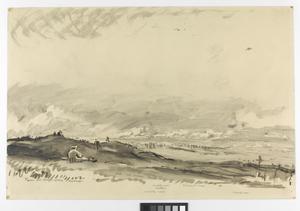

Fricourt Village : After the Capture by the British
The ‘before’ and ‘after’ are shocking contrasts – and they revealed a truth, a reality, previously unavailable to the British public.
[There is a resume of Bone’s war career at https://history.blog.gov.uk/2014/07/22/sir-muirhead-bone-first-official-war-artist/ and many more images can be seen at the Imperial War Museum website: http://www.iwm.org.uk/collections/search?query=muirhead+bone&=Search%5D
It had been recognised that art was not only valuable as propaganda and reportage, but also as document and most importantly as answering the public’s call for truth – people wanted to see, to understand, what the men on the frontlines were going through. The turning point may well have been an exhibition of CRW Nevinson’s paintings.
Nevinson had been at the forefront of the British avant-garde as a member of the Vorticist group [http://www.tate.org.uk/art/art-terms/v/vorticism]; flagrantly displaying a dynamic, aggressive futurist style in his paintings. With the start of war, and unable to enlist with the army for health reasons, he volunteered for the Red Cross, serving as ambulance driver, stretcher bearer and interpreter. The horror of the medical situation just behind the frontlines was shocking; Nevinson describes the hospital quarters “a shed full of dead, wounded and dying”. Invalided home in early 1915, he realised the huge disparity between what he had seen and what the general public imagined: “Back I went to London, to see life still unshaken, with bands playing, drums banging, the armies marching and the newspapers telling us nothing at all” [quoted in Richard Cork’s “A Biter Truth”]. Recovered from his own injuries and working at a London hospital, Nevinson started painting. The Daily News reporters had been calling for a new patriotic art that documented the campaigns, imagining masterpieces with the theme: victory. They did not expect the explicit, full-frontal nerve shattering art that Nevinson would show the world:

Christopher Richard Wynne Nevinson (1989-1946) Bursting Shell [1915; Tate; @Tate @TateImages]
Whilst Bursting Shell combines fragmentation, abstraction and blinding colour to disorientate the viewer, Nevinson also represents the brutal reality of his experiences:
 Christopher Richard Wynne Nevinson (1989-1946) La Patrie [1916; Birmingham Museums @BM_AG; image c/o artuk.org @artukdotorg ]
There is nowhere to turn from the agony and torment of these men lying bandaged on makeshift wooden boards as yet more stretcher-bearers arrive with more wounded men. There is no sentiment here, no patriotism or idealist heroism – just the brutal reality that now has to be faced. And one aspect of this brutal reality was the industrial modernity of the weapons.
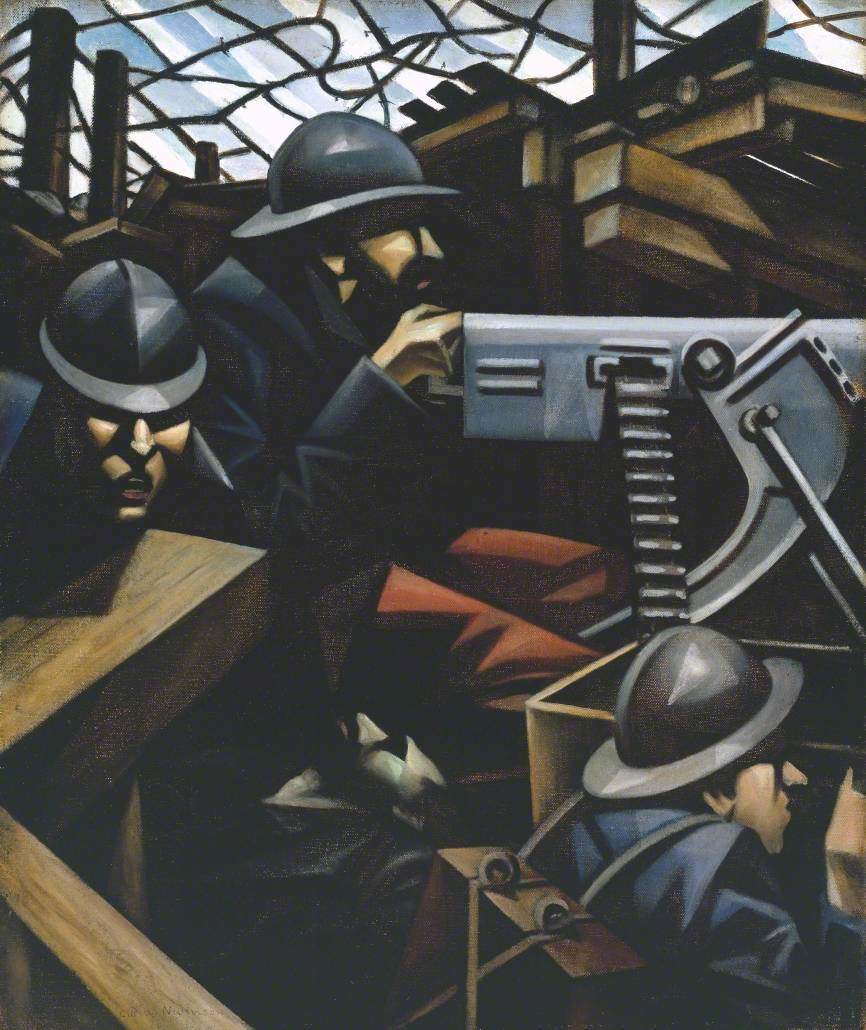 Christopher Richard Wynne Nevinson (1989-1946) La Mitrailleuse [1915; Tate; @Tate]
Nevinson’s representation of the machine gunners is intense; dug-in; claustrophobic as sharp jagged struts and barbed wire enclose them. The men are no longer fleshly human individuals but at one with the gun, cogs in the war-machine as they concentrate at their posts – whilst a dead comrade lies at their feet in the trench.
Whilst many critics had smarted at avant-garde art, it was becoming apparent that modern war had to be represented by modern means; moreover, it was these young men – trained as artists and knowledgeable of Post-Impressionsim, Cubism and Futurism – that were out there fighting, experiencing the trenches, the battles and the carnage.
For those who became Official War Artists, there was no advice given from above – both subject matter and style of painting were left entirely to the artists themselves. And it is perhaps the drawings and sketches made at the front that bring us closest to what these artists experienced, what they were seeing 100 years ago.
Paul Nash had been in the trenches with the Artists Rifles Brigade from February to May 1917; he returned in October as an Official War Artist; his sketches focus the shattered landscape which comes to symbolise the destruction and carnage of all-out-war.

Paul Nash (1889-1946) The Field of Passchendaele [1917; Manchester Art Galleries; @mcrartgallery; image c/o @BridgemanImages]
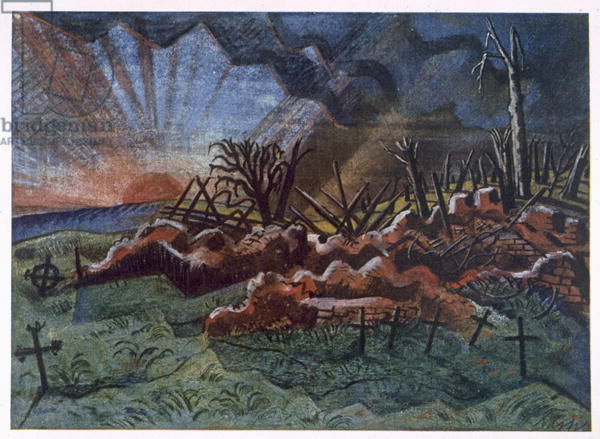
Paul Nash (1889-1946) Sunrise, Ruins of a Hospice, north west of Wytschaete, destroyed by bombardment [1917; private collection c/o @BridgemanImages]
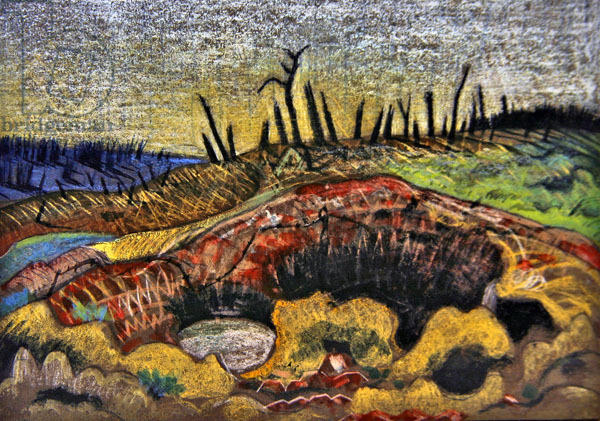
Paul Nash (1889-1946) A Farm, Wytschaete, Belgium [1917; private collection c/o @BridgemanImages]
“I have seen the most frightful nightmare of a country… unspeakable, utterly undescribable… no glimmer of God’s hand is seen anywhere. Sunset and sunrise are blasphemous… The rain drives on, the stinking mud… the black trees ooze and sweat… I am no longer an artist interested and curious. I am a messenger who will bring back word from the men… inarticulate will be my message, but it will have a bitter truth.”
[This was written by Paul Nash on 16th November 1917 to his wife Margaret, quoted in David Boyd Haycock’s book “A Crisis of Brilliance”]
As Paul Nash focused on a terrible landscape of mud, water, blasted trees in the dun colours of gloom or in acidic crayon, Eric Kennington turned to portrait sketches. Far from the authority figures photographed for the press at the start of the war, the ‘ordinary’ Tommy was increasingly important not as the abstract ‘machine cog’ (as in Nevinson’s paintings) but as an individual.
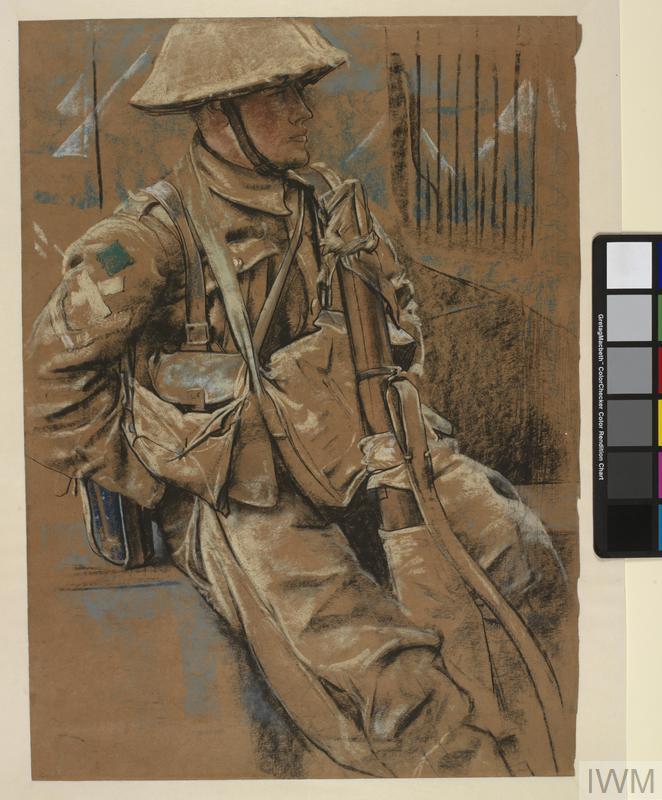
Eric Kennington (1888-1960) Back to Billets [1917; Imperial War Museum @I_W_M]
Like Kennington, William Orpen was out in France for most of 1917 completing an enormous portfolio of works, now in the Imperial War Museum [http://www.iwm.org.uk/collections/search?query=william+orpen+1917&=Search], showing scenes from soldier’s activities to shattered buildings. Perhaps most harrowing are his depictions of the physical and psychological damage of war.
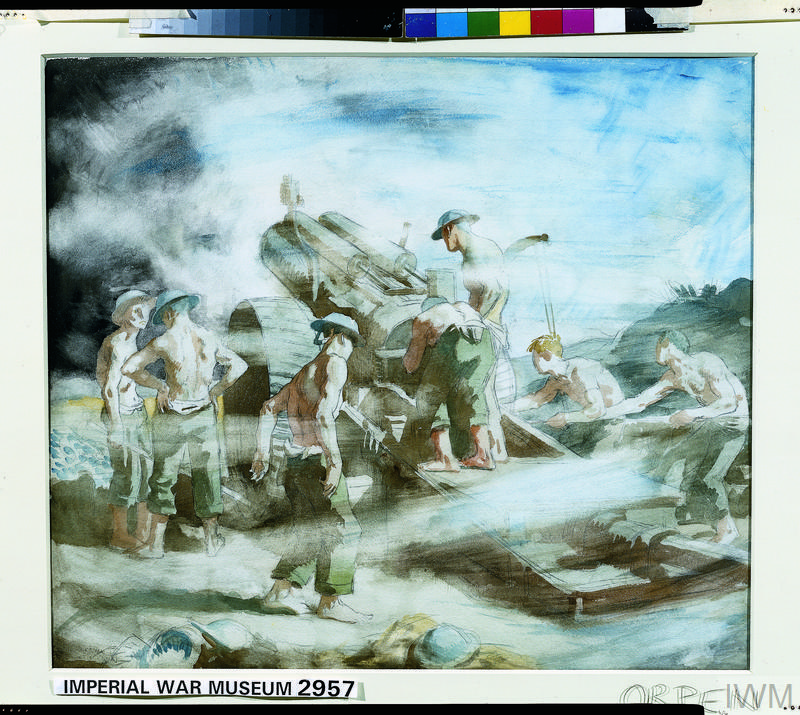
William Orpen (1878-1931) A Howitzer in Action [1917; Imperial War Museum @I_W_M]

William Orpen (1878-1931) The Main Street, Combles [1917; Imperial War Museum]

William Orpen (1878-1931) The Receiving Room – The 42nd Stationary Hospital [1917; Imperial War Museum @I_W_M]
Whilst women artists were not permitted to go to the front, many were working just behind the front lines having volunteered for the medical corps. such as Olive Mudie-Cooke whose watercoloured drawings reveal not only everyday activities but the care taken by nurses over the wounded soldiers.
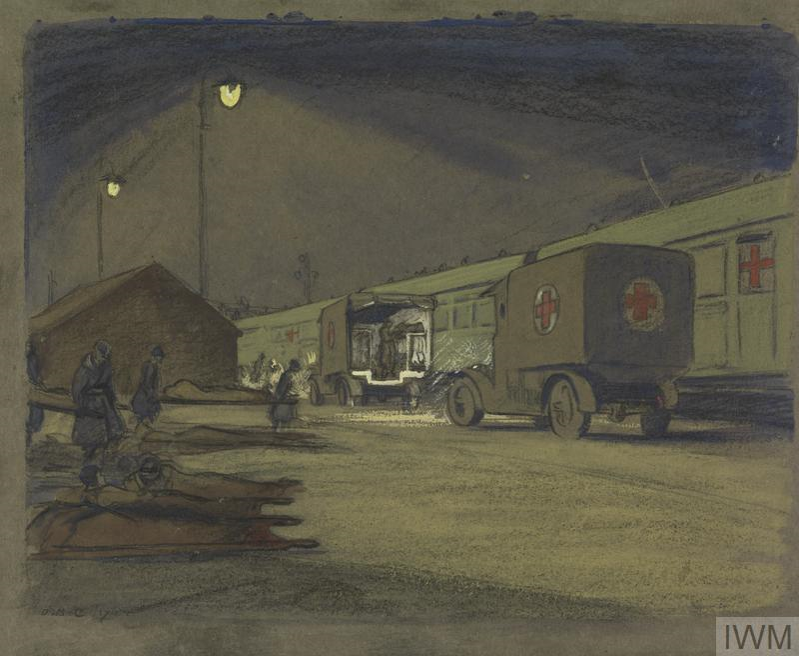
Olive Mudie-Cooke (1890-1925) Etaples Hospital Siding : a VAD convoy unloading an ambulance train at night [1917; Imperial War Museum]
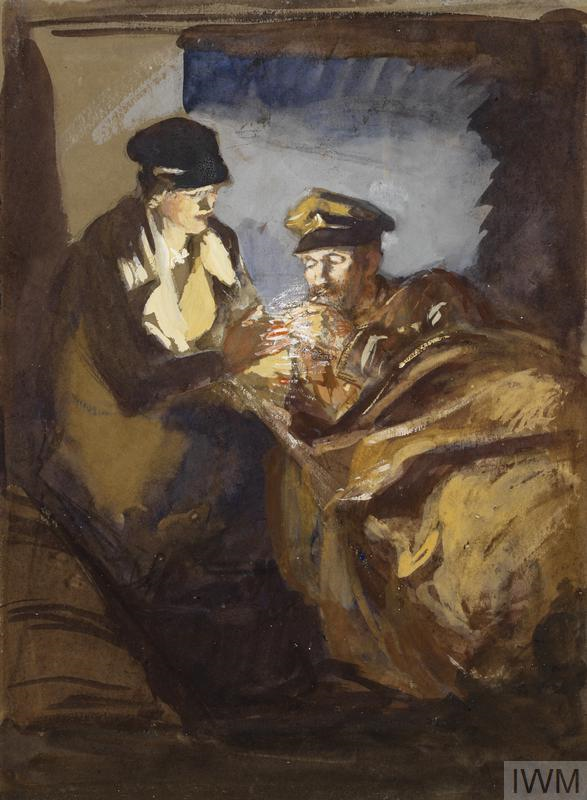
Olive Mudie-Cooke (1890-1925) In an Ambulance : a VAD lighting a cigarette for a patient [c.1918; IWM]
These artists were bringing their scenes of experience to viewers at home hungry for knowledge. Mind, the Home Front, as crucial to the war effort as the frontline in many ways, also saw dramatic changes and new experiences. These again were recognised by the official war commission – and I’ll return to these in a separate posting – as they are key to the recognition of women as factory workers, farm-works and, indeed, artists.
One other aspect of art from World War I also worth recognising is that of aerial perspectives. The use of aircraft in war was again new and, as artists were increasingly commissioned from across the forces, so brothers Sydney and Richard Carline – pilots in the Royal Flying Corps – became Official War Artists in 1918. Their sketches (and eventual paintings) would show unique views of the landscape in Europe and beyond, as they take us – the viewer – aloft with them.
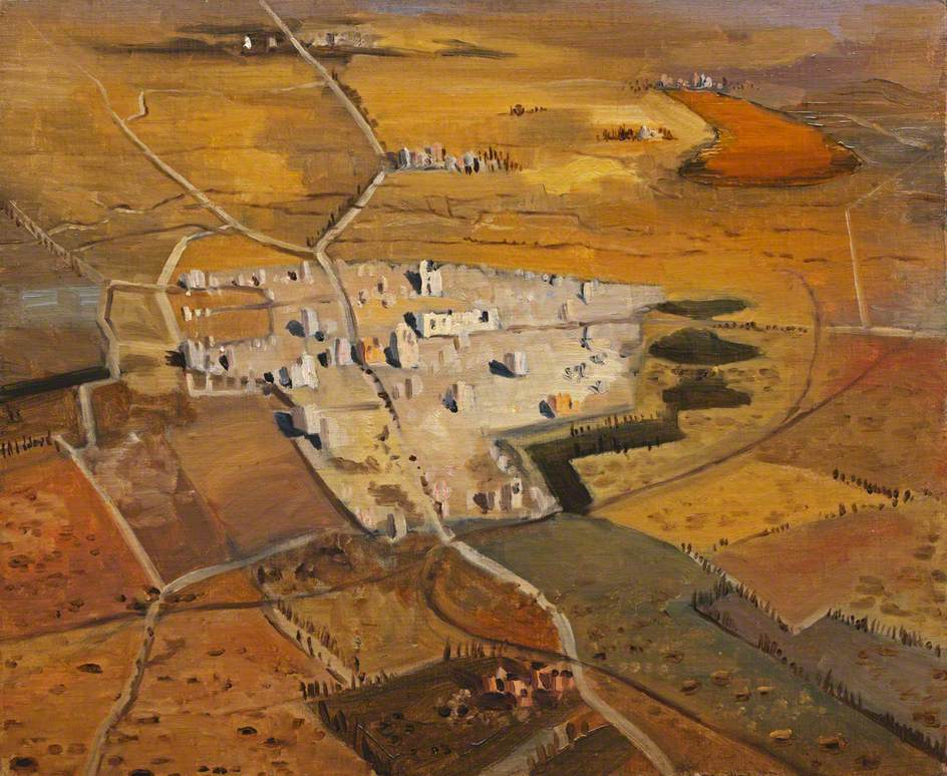
Richard Carline (1896–1980) Ypres Seen from an Aeroplane [1918; IWM]
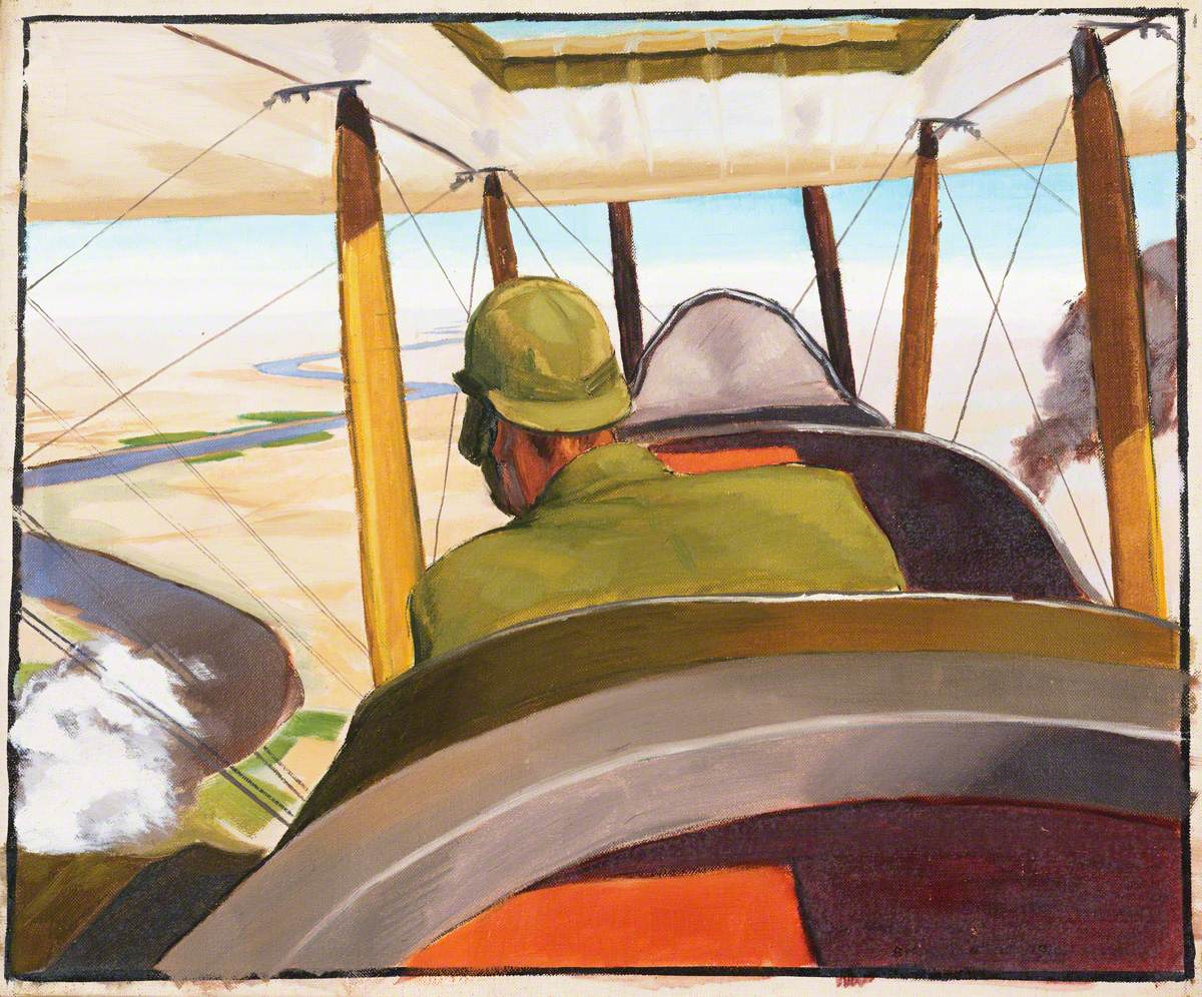
Sydney William Carline (1888–1929) A British Pilot in a BE2c Approaching Hit along the Course of the River Euphrates, July 1919 [1919; IWM]
Again, there’s much more at http://www.iwm.org.uk/collections/search?query=Carline+1918&=Search
Recommended books:
The Imperial War Museum’s “Art From the First World War” is of course a brilliant introductory overview of key works.
David Boyd Haycock’s excellent “A Crisis of Brilliance” tells the story of the Slade generation caught up in the war, and for a more fictional account try Pat Barker’s brilliant trilogy “Regeneration”.
Posted in Uncategorized
 thecommonviewer