over at Pebbles cafe (in the Havens building on Hamlet Court Road)
to discuss Jerry Brotton’s book on the art collection of Charles I
Set against the backdrop of war, revolution, and regicide, and moving from London to Venice, Mantua, Madrid, Paris and the Low Countries, Jerry Brotton’s colourful and critically acclaimed book, The Sale of the Late King’s Goods, explores the formation and dispersal of King Charles I’s art collection. Following a remarkable and unprecedented Parliamentary Act for ‘The sale of the late king’s goods’, Cromwell’s republican regime sold off nearly 2,000 paintings, tapestries, statues and drawings in an attempt to settle the dead king’s enormous debts and raise money for the Commonwealth’s military forces. Brotton recreates the extraordinary circumstances of this sale, in which for the first time ordinary working people were able to handle and own works by the great masters. He also examines the abiding relationship between art and power, revealing how the current Royal Collection emerged from this turbulent period, and paints its own vivid and dramatic picture of one of the greatest lost collections in English history.
*
The ‘Words & Pictures’ book club is a safe and generous group of people fascinated and intrigued by art and artists to discuss books and pictures over coffee and a slice of cake – all welcome!
Join us on Saturday 28th May, 11am-1pm at The Beecroft Gallery, Southend
as we take a plunge into the early years of Surrealism in Paris and London.
La Galerie Surrealiste, rue Jacques Gallot, photographed by Man Ray 1927.
*
“one of the most genuinely subversive movement in the history of ideas” – Michel Remy
*
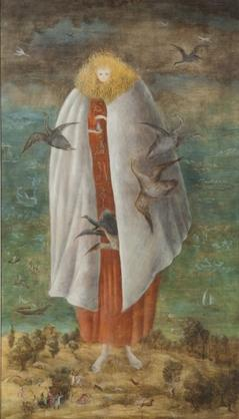
Leonora Carrington (1917-2011)
The Giantess (The Guardian of the Egg) [1947; private collection]
“When one is overcome by demoralization and defeat, depressed or on the verge of suicide, that is the time to open one’s Surrealist Survival Kit and enjoy a breath of magical fresh air. To lay out its marvellous contents carefully before you and let them play …” wrote artist, novelist and poet, Leonora Carrington in 1936.
*
We’ll discuss Andre Breton’s Surrealist Manifestos, the influential paintings of Giorgio de Chirico and Max Ernst and meet some of the first British artists inspired by Surrealism.
Attendance is £10 on the door and will include tea, coffee & biscuits – all welcome!
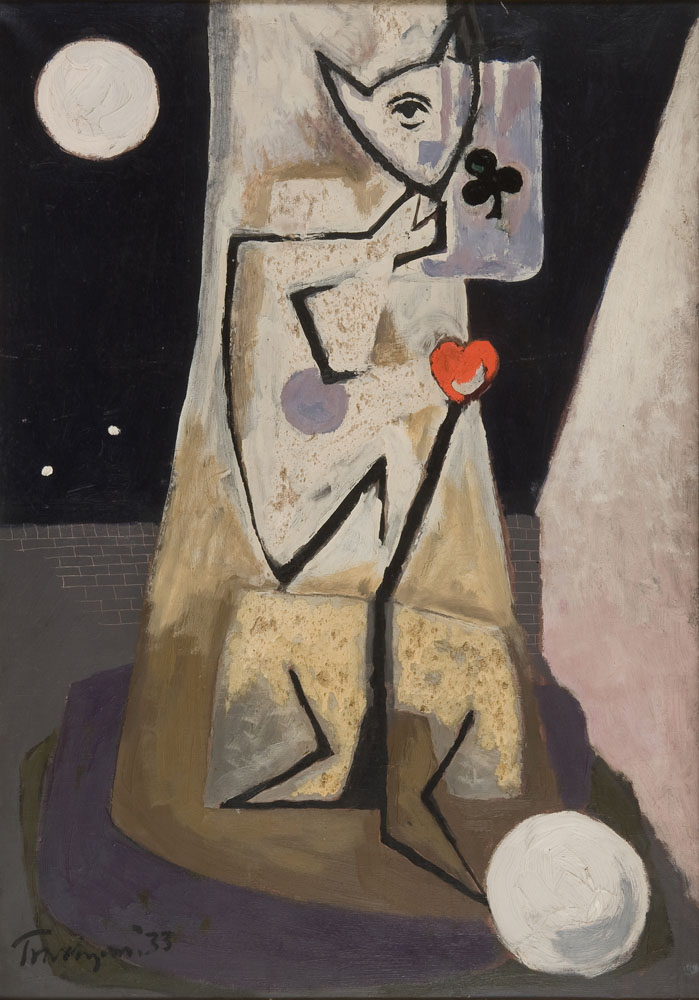
Julian Trevelyan (1910-1988): Standing Figure with Ace of Clubs [1933; c/o Pallant House Gallery]
“Let us gladly shout: to dream is to create” – Julian Trevelyan
Friday 27th May, 2pm at “Pebbles” café (the old Havens) on Hamlet Court Road.
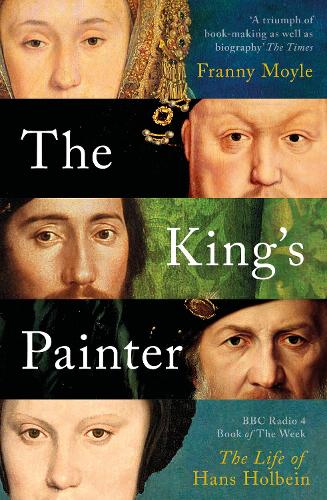
This month’s book is:
The King’s Painter: The Life and Times of Hans Holbein
by Franny Moyle
Hans Holbein the Younger is chiefly celebrated for his beautiful and precisely realised portraiture, which includes representations of Henry VIII, Thomas More, Thomas Cromwell, Anne of Cleves, Jane Seymour and an array of the Tudor lords and ladies he encountered during the course of two sojourns in England. But beyond these familiar images, which have come to define our perception of the world of the Henrician court, Holbein was a protean and multi-faceted genius: a humanist, satirist, political propagandist, and contributor to the history of book design as well as a religious artist and court painter. The rich layers of symbolism and allusion that characterise his work have proved especially fascinating to scholars. Franny Moyle traces and analyses the life and work of an extraordinary artist against the backdrop of an era of political turbulence and cultural transformation, to which his art offers a subtle and endlessly refracting mirror.
Happy reading – I look forward to hearing what you think!
Join us for our monthly Book Club to discuss: “Circles & Squares”…
A spellbinding portrait of the Hampstead Modernists, threading together the lives, loves, rivalries and ambitions of a group of artists at the heart of an international avant-garde. Hampstead in the 1930s. In this peaceful, verdant London suburb, Barbara Hepworth and Ben Nicholson have embarked on a love affair – a passion that will launch an era-defining art movement. In her chronicle of the exhilarating rise and fall of British Modernism, Caroline Maclean captures the dazzling circle drawn into Hepworth and Nicholson’s wake: among them Henry Moore, Paul Nash, Herbert Read, and famed emigres Walter Gropius, founder of the Bauhaus, and Piet Mondrian, blown in on the winds of change sweeping across Europe. Living and working within a few streets of their Parkhill Road studios, the artists form Unit One, a cornerstone of the Modernist movement which would bring them international renown. Drawing on previously unpublished archive material, Caroline Maclean’s electrifying Circles and Squares brings the work, loves and rivalries of the Hampstead Modernists to life as never before, capturing a brief moment in time when a new way of living seemed possible. United in their belief in art’s power to change the world, her cast of trailblazers radiate hope and ambition during one of the darkest chapters of the twentieth century.
[published by Bloomsbury, 2020]
*
These discussion meeting are free of charge, relaxed & informal and take place at “Pebbles” cafe (in the old Havens building on Hamlet Court Road), starting 2pm – all welcome!
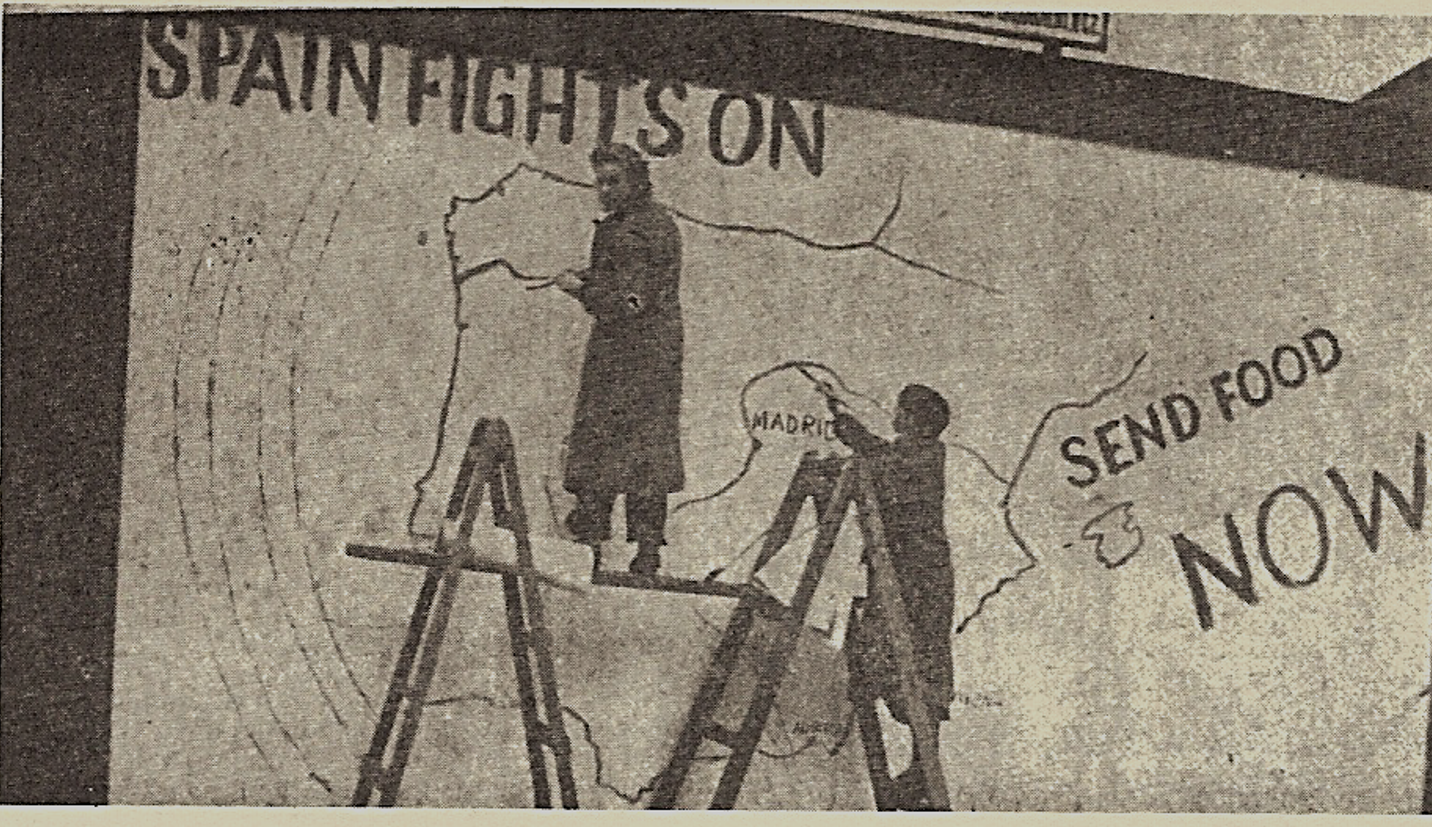
As the political situation of 1930s Europe worsened, the Artists International Association adopted a ‘popular front’ methodology encouraging a wide range of artists to exhibit under their pro-communist anti-fascist umbrella. This became especially important with the outbreak of the Spanish Civil War when the AIA sought to raise funds for sending food, supplies and ambulances to the frontlines and assisting refugees trying to escape.
Artists Nan Youngman & Priscilla Thornycroft painting: Spain Fights On
Today we will look at the work of the Artists International Association and British artists’ responses to the Spanish Civil War.
Please note we have a new venue and a new meeting time:
The Beecroft Art Gallery, Southend
11am-1pm om Saturday 7th May
£10 on the door as usual
All welcome!
*
A couple of initial resources:
The Exhibition “Conscience and Conflict” at Pallant House Gallery and a BBC article about it; there is also a book (out of print, but maybe at the library):
Our next art discussion meeting will consider the Artists International Association, an exhibiting society founded in 1933. It’s aim was the ‘Unity of Artists for Peace, Democracy and Cultural Development’.
In turn we will look at the formation of working class art groups such as the East London Group and the Pitman Painters (the Ashington Group) as well the arrival of Mass Observation in “Worktown”.
All welcome!
Saturday 26th March, 10am-midday
Civic Centre Committee Room, Southend
£10 tickets on door
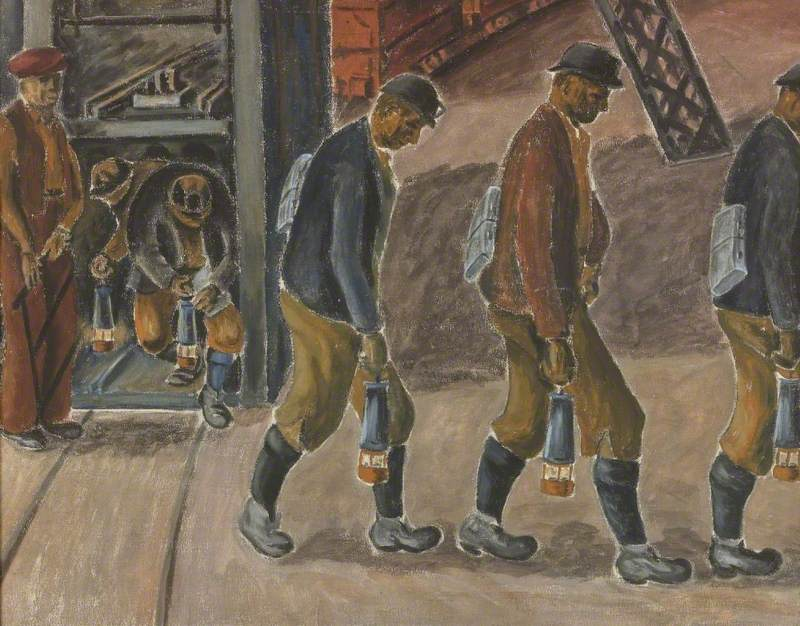
Oliver Kilbourn (1904-1993): End of Shift [c.1934; Laing Art Gallery; artuk.org]
Peal Binder (1904-1990): A Jewish Restaurant in Brick Lane [c/o SpitalfieldsLife]
Brynhild Parker (1907-1987): Windy Day on Marine Parade [c.1925; Beecroft Art Gallery; artuk.org]
Greetings!
It gives me huge pleasure to announce that I will be in conversation with Alan Waltham, curator and custodian of The East London Group on
Friday 11th March, 2022 at 2.30pm
Venue: The Beecroft Art Gallery, Southend
£10 tickets are available via Eventbrite (click on link)
Join Alan Waltham, curator of “Brothers in Art: Walter and Harold Steggles” currently on show at the Beecroft Gallery to discuss the East London Group.
The rediscovery of the East London Group, triggered by a surprise inheritance and the 2012 publication of David Buckman’s “From Bow to Biennale”, has garnered a revitalised appreciation of these working class artists’ paintings, many of which hadn’t been seen since the 1930s.
This afternoon, curator Alan Waltham discusses this renewed recognition of the East London Group, his personal link to the Steggles Brothers and, by way of some of the most iconic of their paintings, the origins and history of the Group. Alan will be in conversation with Dr ML Banting, independent researcher in the field of early 20th-century British art.
All welcome!
“Brothers in Art: Walter and Harold Steggles” runs at the Beecroft Gallery until 3rd April, 2022. There are further details about both the exhibition and the East London Group artists here and on artuk.org here.
Photograph: East London Group artists Elwin Hawthorne, Phyllis Bray, John Cooper and Brynhild Parker at the Lefevre Galleries [c. 1932] from the article “Phyllis Bray, Artist” at SpitalfieldsLife website.
From the Introduction of “Frances Hodgkins: European Journeys” by Catherine Hammond and Mary Kisler:
“Frances Mary Hodgkins (1869-1947) has always been difficult to locate within existing art-historical frameworks. Resisitant to any particular style, forever on the move, her place within modernist art has never been settled. Born in New Zealand in the second half of the nineteenth century, she exemplified the progressive attitude and spirit of the ‘colonial woman’: a single, talented local artist who left for Europe in her early thirties. From that point onwards, Hodgkins seldom had a fixed abode, and determinedly avoided any encumbrance, without property or any family of her own, her entire life. Instead she worked, as she wished, as an independent professional artist in a career that spanned six decades, drawing inspiration from the changing scene around her that her freedom and transience afforded.”
Hodgkins life, let alone her art, is then utterly fascinating, especially when as Hammond and Kisler write next: “It was not until Hodgkins was approaching the age of sixty that she began to establish a central place for herself within British modernism.”
The book brilliantly illuminates the artist’s journey with some glorious reproductions of paintings many of which are located in New Zealand and Australia, which leads us to online resources:
Frances Hodgkins: European Journeys by Catherine Hammond and Mary Kisler [2019; Thames & Hudson]
The “European Journeys” book was published to coincide with an exhibition at Christchurch Gallery and their website is certainly worth exploring.
Another recent exhibition, at the Jonathan Grant Gallery in Auckland also has a fabulous website: Frances Hodgkins and her Circle
And the Museum of New Zealand has many of Hodgkins’ paintings in its collection.
The Tate Gallery in London also holds some [here], including:
“Loveday and Ann” is one of Hodgkins’ earliest oil paintings. Having had a flourishing career in Paris, as an exhibitor and teacher of watercolour, the outbreak of war brought her to the safety of Cornwall. Her art, however, inspired by the modern French avant garde, from Vuillard to Matisse and Picasso, confused, disorientated and shocked the British viewer. “This is the exhibit of a pyrotechnic artist in paint, it is not portraiture, or if it is, I never want to meet Loveday and Ann” was one critics 1916 response, notes Samantha Niederman.
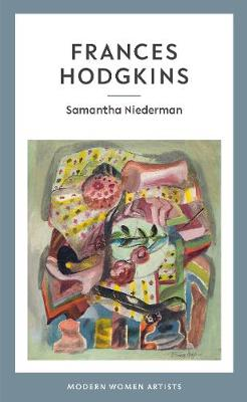
“Frances Hodgkins” by Samantha Niederman [2020; Eiderdown Books’ Modern Women Artists series]
For me, “Ann and Loveday” represents the full glory of Hodgkins’ paintings: the combination of gorgeous colour, the flowering of multiple patterns and a finger-tingling texture. There’s something vibrant about them – the very paint is exhilarating. And whilst it is possible to relate some of the painterly ideas and experiments to Fauvism, Cubism, Abstraction and Surrealism; Hodgkins works are the creations of a particular singular vision. How to describe that vision in words is, as it should be, next to impossible. One late exhibition was reviewed by John Piper, who extolled the artist’s ‘songlike expression’ and focused on her achievement as a colourist, borrowing terms, as many others had, from music: ‘…it means talking of scintillations and explosions, chromatic runs and exciting leaps…’ – but then how else might one encapsulate another painting that is in the Tate:
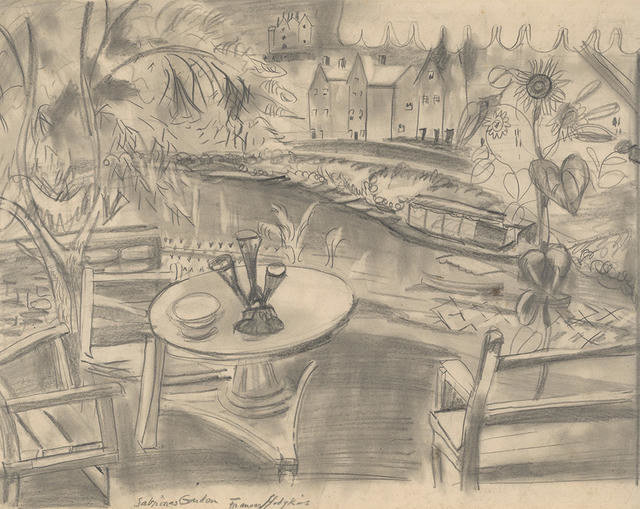
It really is a poem in paint; the visualisation of a distilled memory of a visit to Bridgnorth possibly a few years earlier. Tate quotes Hodgkins’ friend Hannah Ritchie saying it was “a picture done in her studio after a good deal of thinking round the material she [had] gathered”, and they link it to a pencil drawing at Christchurch Art Gallery, “Sabrina’s Garden”:
which really would exemplify the artist’s mind, that visionary creativity that can translate “nature” into “art”. It would also seem pertinent in relation to “The Lake” to quote Eric Newton who declared: Frances Hodgkins “can juggle with colour orchestrally”. We might even to go further for her colours seem incredibly unique. A late painting, for example:
is “Ornaments” [1942; Auckland Art Gallery Toi o Tāmaki] combines a still life with landscape – a development, as Frances Spalding notes, of the Seven & Five Society’s interest in still life on a window sill [European Journeys: “Frances Hodgkins and British Modernism” pp7-24]. But those colours! There’s alchemy at work here surely as the browns, pinks, greens and yellows unite with rhythmic lines, pulsating textures and eye-bewitching patterns, to conjure a mesmerising harmony of golden light.
at The Pebbles Cafe in the old Havens building on Hamlet Court Road
to discuss (amongst other things no doubt!):
“Angelica: Paintress of Minds” by Miranda Miller [2020, Barbican Press]
There is a great article by Miranda Miller about Angelica Kauffman in Historia [here] in which she notes:
Like us, Angelica lived at a time of enormous change and was often bewildered by it. At the end of her life, still anxious to avoid scandal, she made a bonfire of most of her private papers. In my novel I’ve presumptuously tried to bring them back to life.
And a number of Kauffman’s paintings can be seen on the Royal Academy site [here] including











 thecommonviewer